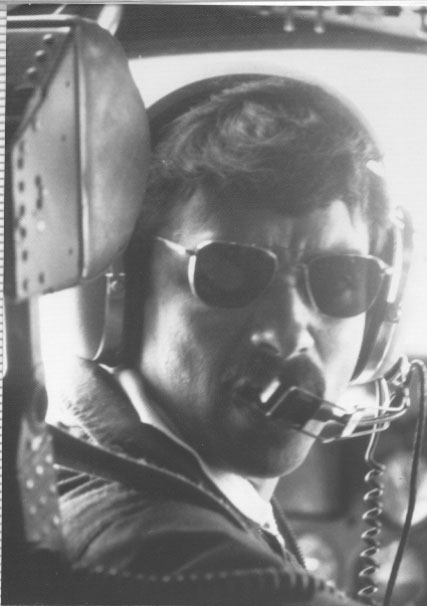
 This photograph
is of a Navy friend, Manny Gurule.
This photograph
is of a Navy friend, Manny Gurule. VC-2
NAS Oceana, Virginia Beach, VA
December 1973 - June 1976
This photograph
is of a Navy friend, Manny Gurule.
Manny and I became friends at VC2, NAS Oceana Virginia and spent many hours in either our A4s or in this case an S2. Manny is seen here in the left-hand seat, flight commander.
Once airborne in the S2s, the pilots could switch to headphones and boom microphones.
The S2 Tracker was designed to seek out submarines and operate from the flight deck of a carrier. Our mission with the S2 was towing targets for ships gunnery practice. Since the aircraft was towing targets and being shot at, the multi-colored paint job on the S2 was not made to look nice but to be easily seen at low altitudes over the water.
The S2 was powered by two R-1820 engines, 18 big cylinders with turbo-chargers. I'm not sure if I remember correctly, but I believe they produced about 1100 horse power each.
Folding wings are uncommon for commercial aircraft, but not for aircraft that live aboard the flight-deck of an aircraft carrier. Once the wings were unlocked, hydraulic pressure was used to fold the wings of the S2 in half so that they would occupy less deck space in the hanger bays.

Seen here, the S2 is undergoing an engine overhall. During a flight to New Mexico from Virginia Beach, the port engine cracked an exhaust manifold and broke part of the cylinder head. Ron Carpenter, Al Alvarez and Manny Gurule (mounted on the prop) are repairing the cylinder at a reserve base in Tennessee.
Once during 1974, two pilots flying one of our S2s, dropped me off at my hometown airport in Hamilton, Ohio. Needless to say, not many S2s have landed at the Hamilton Airport.
Still useful after more than 30 years of service with the U. S. Navy, S2 Trackers are being overhauled here at Higley Field in Mesa, Arizona for use in fighting forest fires in the west. As part of the conversion to a fire fighter, the S2s torpedo bay, previously converted into longer duration fuel tanks, were modified to hold and release water and fire-retardant chemicals.
Another version of this basic aircraft was used as a ferry to move supplies, passangers and mail to and from the aircraft carrier. The COD (Carrier On-board Delivery) C2 aircraft looked much like the S2 externally, missing only the torpedo bay, and internally utilizing some rear facing passanger seats.
 This photograph
was taken by my brother Jim Perrine. Taken in December '74, at Wright Patterson
Air Force base in Dayton, Ohio, it is a picture of the number 3 aircraft
of Fleet Composite Squadron 2, based at Naval Air Station Oceana in Virginia
Beach, Virginia. I am actually in the cockpit in this picture, one
of the very few I have.
This photograph
was taken by my brother Jim Perrine. Taken in December '74, at Wright Patterson
Air Force base in Dayton, Ohio, it is a picture of the number 3 aircraft
of Fleet Composite Squadron 2, based at Naval Air Station Oceana in Virginia
Beach, Virginia. I am actually in the cockpit in this picture, one
of the very few I have.
The JE letters on the tail were the squadron's call sign, pronounced "Juliette Echo" followed by the numbers "03". Note take-off settings of 8 degrees nose up trim (horizontal stabilizer position) and spoilers armed and flaps at 1/2 position (red panels at the trailing edge of the wing).
The blue-field with white star paint on the aircraft was the configuration for all of the squadron aircraft for the U. S. Bicentennial.