Aviation Officer Candidate
School
Pensacola, Florida
July 4, 1972 - October 1972
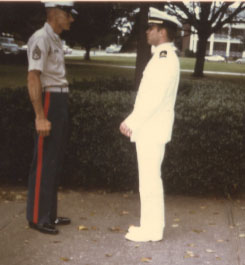
Attending the Navy's Aviation Officer Candidate School at Pensacola was certainly an experience I will never forget. Like any boot camp it was intense and demanding. The Marine Drill Instructors assigned to mature us in the 13 weeks of education, took their jobs very seriously and there wasn't anything we could do or try that they hadn't seen before.
Since the cost of training a pilot in jet aircraft is so very expensive, a major part of boot camp was to test our committment to the program. Thirty-six of us, all volunteers, commenced the program on July 4 and 13 weeks later, only about 18 were commissioned as Ensigns in the United States Naval Reserve.
Your first week at AOC school you undergo a major mental adjustment.
On day one, they cut most if not all of your hair off, take away all of
your clothes and possions and give you a green ill-fitting one-piece jump
suit, high top boots and a chrome painted helmet liner to keep you from
sunburning your scalp. You are referred to only as a "poopie",
and even this lovely name was screamed at you as if you were dirt.
The physical workouts start right away. I thought I was in pretty good shape when I arrived, but that didn't make any difference. The Marine instructors pushed everyone right to the edge of breaking down, and every so often even to breaking. At every point along the way, you were told that you weren't good enough and you might as well quit right then. That choice to quit was always there as a way out of the pressure, pain, stress, heat or frustration.
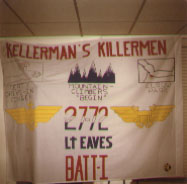
Our class, numbered 27-72 started training on the 27th week of 1972. Staff sargent Kellerman was our drill instructor and along with an instructor under training stayed with us the full 13 weeks of training. This banner was created for a regimental athletic competition between the students undergoing training, probably about 500-600 students in all. Lt. Eaves was our class officer. He reviewed our physical and mental training progress during the weeks at Pensacola and had overall responsibility for our progression through AOC school.
After a week, you moved out of this "poopie" status and were able to wear the normal working uniform like the rest of the base.
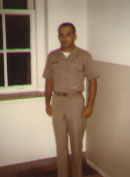 Even when we had
a few minutes to take a picture, we stood very rigid at attention. That
was the only position that we felt comfortable using around the base. This
picture was taken in our barracks, just outside our room. Each room housed
4 students. All of us became very familiar with this particular corner
of the hallway. During room inspections, the drill instructors would find
something out of place in the room and we were assigned to do "Roaring
20s". Roaring 20s consisted of starting at this corner of the barracks,
doing one push-up, running to the other end of the barracks (about 80 yards)
and doing one push-up there. On returning to this corner, performing two
push-ups. This continued until you reached 20 at each end of the building.
We never did reach 20. Usually the drill instructors needed us for some
other type of character building activity by the time we reached 6 or 7
(not that we could do many more push-ups at that point anyway!).
Even when we had
a few minutes to take a picture, we stood very rigid at attention. That
was the only position that we felt comfortable using around the base. This
picture was taken in our barracks, just outside our room. Each room housed
4 students. All of us became very familiar with this particular corner
of the hallway. During room inspections, the drill instructors would find
something out of place in the room and we were assigned to do "Roaring
20s". Roaring 20s consisted of starting at this corner of the barracks,
doing one push-up, running to the other end of the barracks (about 80 yards)
and doing one push-up there. On returning to this corner, performing two
push-ups. This continued until you reached 20 at each end of the building.
We never did reach 20. Usually the drill instructors needed us for some
other type of character building activity by the time we reached 6 or 7
(not that we could do many more push-ups at that point anyway!).
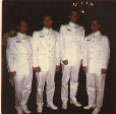 The picture here
was taken after about 8 weeks of training at a formal function requiring
the dress white uniform.
The picture here
was taken after about 8 weeks of training at a formal function requiring
the dress white uniform.
For the first 8 weeks, the goal of the drill instructors seemed to be to break you down, frustrate you at every turn. After that point, things improved. The pace of physical workouts was still intense, but the efforts rarely went to far.
Of course during this entire period we were spending about 6 hours a day in classes on math, aerodynamics, Naval history, Naval law and the many other topics required by the program. Each day began at 5:45AM and the lights were out at 10:00PM. No one had any trouble sleeping.
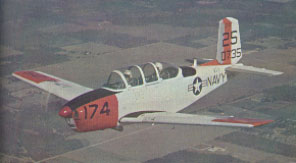
After 11 weeks of this intense program, we were able to actually start training for flying. In '72 the Navy was using the T34 propeller driven primary trainer. This little airplane had retractible landing gear and a sliding canopy for each the instructor and the student. The take-off and departure procedures for the Saufley Field were intentionally complicated to test the students ability to handle relatively complex procedures quickly. The 30 flight hours spent in primary were used to make the selection as to who would be assigned to jets, props or helicopters.
Once we qualified in the T-34, we became commissioned officers in the United States Naval Reserve. This was a formal affair where the students wore dress white uniforms. After graduation, as the new Ensigns exited the auditorium, we received our first salute from our drill instructor, Staff Sargent Kellerman. Part of this tradition is to fold a one-dollar bill into a specific triangle shape and hold it between the fingers of your right hand. After the salute and congratulations from your drill instructor, you would shake hands. Staff sargent Kellerman assured us that the dollar bill would disappear.